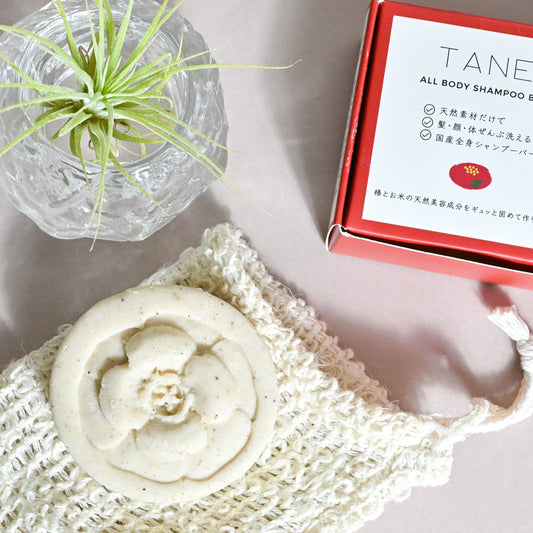
In Japan, where liquid shampoo is the norm, "shampoo bars (solid shampoos)" are still not very well known.
However, in Europe and America, they are already sold alongside liquid shampoos in drugstores, and have become a part of daily life as "environmentally friendly and easy-to-use hair care products."
Many people who actually try them feel that they "lather well," "leave hair moisturized and manageable," and are "surprisingly easy to use," and are now starting to attract attention in Japan for their functionality and convenience.
In this article, we will cover the basics of shampoo bars, their spread in Europe and America, the benefits of using them in Japan, and the "shampoo bar for Japanese people" that we propose.
What are solid shampoo bars?
What is a shampoo bar?
A shampoo bar is a solid shampoo made by solidifying the ingredients of liquid shampoo without water.
It is used by lathering directly on the hands or hair, or by rubbing it on a net.
Although it looks like soap,
it is truly a shampoo specifically for "hair and scalp."
Since it doesn't use water, it's compact and light, and some products can last 2-3 months per bar.
It's great for daily use, as well as for travel and the gym.

Differences from soap
While they may look similar,
shampoo bars and soap are completely different.
| Comparison Item | Shampoo Bar | Soap |
| Main Use | Hair/Scalp, some can wash the whole body | Body |
| Cleansing Ingredients | Amino acid-based, Cocoyl Isethionate, etc. | Fatty acids + caustic soda (soap) |
| pH | Mildly acidic to neutral, similar to hair and skin | Alkaline |
| Effect on hair | Smooth, some do not require conditioner | Can be squeaky and dry |
In other words, a shampoo bar is not "washing with soap,"
but rather "a solid with the function of shampoo."
🔗 [Related Articles]
👉 Differences between "Soap" and "Shin Soap (Shampoo Bar)" and all ingredients
👉 Who is not suited for soap shampoo / shampoo bars?
Advantages and Disadvantages of Shampoo Bars
<Advantages>
・Zero plastic waste: Sustainable and eco-friendly
・Ideal for travel and gym: No leaks & light and compact
・Long-lasting & economical: A small amount lathers well, excellent cost performance
・Some types do not require conditioner: Allows for quick care
🔗 [Related Articles]
👉 Are rinse-free shampoo bars really convenient?
<Disadvantages>
・Prone to melting if left wet: Requires dry storage
・Lathering takes some getting used to at first: No problem once you get the hang of it
・Some products are soap-based: Check ingredients carefully
How widespread is it in the West?
Especially in countries with high ethical awareness
like the UK, France, Germany, and the US,
shampoo bars are already a permanent fixture in drugstores.
In some regions, natural cosmetic brands and organic supermarkets even offer a wider selection of solid types than liquid types.


Posts are increasing daily on social media.
They are gaining popularity not only for their environmental friendliness but also for their design, fragrance, and gentleness on the skin,
and are spreading as "just good products" among those with a strong sense of beauty.
Who is it popular with?
Shampoo bars are chosen by people like these:
Minimalists and sustainability-conscious individuals
・The idea of "zero waste after use" is appealing.
・Without bottles, the bathroom stays neat and tidy.
👉 Convenient for travel and回家! Hair & skincare items for minimalists

People with sensitive skin and those who care about ingredients
・Many formulations are additive-free and low-irritant, so scalp problems are less likely.

People who travel or go to the gym frequently
・No leaks, lightweight, and compact, making it overwhelmingly convenient for travel.
👉 How to conveniently carry shampoo bars in an aluminum tin case [Great for travel and going out!]

Beauty-conscious individuals
・The number of users among overseas celebrities and influencers is rapidly increasing.
・Many people adopt it as a form of "stylish eco-consciousness".
👉 The Reason Shampoo Bars are Rapidly Gaining Popularity, Even Among Celebrities

Pursuing a whole-body shampoo bar for Japanese people
CHANT is a brand born from a mother's desire to
"create something that her son could wash with without itching."
Her child's skin would turn red no matter how many products claimed to be "for sensitive skin."
Seeing this, she decided, "Then I'll just have to make it myself!"
and thus, the additive-free, mildly acidic, 100% plant-derived, clay-hardened, handmade whole-body shampoo bar was born.
CHANT's whole-body shampoo bars are designed to be
gentle and easy to use, with a formula that suits Japanese hair, skin, and lifestyle,
pursuing perfection in every detail.
That's why we're particular about the origin of our ingredients.
CHANT uses traditionallocal Japanese resources.

Features of CHANT's All-in-One Shampoo Bars
・Made in Japan, additive-free formula: Carefully selected ingredients, safe for sensitive skin
・Washable from head to toe: Hair, face, and body with just one product
・Smooth hair even without conditioner: Saves time and water
・Highly moisturizing & smooth lather: Rich enough for a foam mask
・Two types to choose from: Fragrance-free simple TANE and KIYOME, rich in beauty ingredients
 |
 |
👉TANE won the Social Products Award 2025!
👉Differences between TANE and KIYOME: Gentle TANE and KIYOME for relaxation and anti-aging
Start with a "gentle choice" for your daily hair care.
Shampoo bars are already an established part of daily life in the West, as one of many options.
They are sure to become increasingly widespread in Japan as a choice that delivers on all three counts: "good for hair," "good for the environment," and "feels good."
They are sure to become increasingly widespread in Japan.
Why not start a life with "solid shampoo" today?
If you purchase from the official CHANT online shop,
you can rest assured with our "14-day return guarantee."

Why not try it out and feel the difference on your skin directly?