Are you familiar with the term "upcycling"?
Upcycling is the process of taking something that would otherwise be discarded and transforming it into something of greater value by adding new ideas and ingenuity.
For example, making a bag from old denim or turning a used glass bottle into a stylish vase are both forms of upcycling.
Upcycling not only reduces waste, but also has the power to revitalize local communities and protect the planet.
Here, we will discuss its meaning from three perspectives:
"regional revitalization," "waste utilization," and "circular economy."
Regional Revitalization - Discovering and Utilizing Local Treasures
Japan has many undiscovered treasures.
For example, on the small island of Toshima in Tokyo,
Japanese camellia (yabutsubaki) trees have been cultivated for centuries.
Camellia oil extracted from the fruit of the camellia is a natural blessing that beautifies hair and skin.
However, the seeds left after extracting the oil were mostly discarded for a long time.
If these seeds were utilized to create new products, it would create more jobs for the islanders.
Money would circulate locally, encouraging young people to stay and work on the island.
This is "regional revitalization."
It is a way of thinking that aims to distribute jobs and money, which are concentrated in urban areas, to regional areas,
so that people can live prosperous lives wherever they reside.
Upcycling is perfect for regional revitalization.
Because it allows for greater utilization of resources that local people have carefully nurtured.

Waste Utilization - Reducing Waste, Protecting the Environment
Next, let's consider "waste utilization."
In food factories and agricultural settings,
there is a lot of "waste" in the form of vegetables that are still edible but cannot be sold due to their shape,
or peels and seeds produced during processing.
For example, in Tsuruoka City, Yamagata Prefecture, there is a sake brewery that has been in operation for over 400 years.
Sake lees (sakekasu) produced during sake brewing were traditionally used in food and pickles,
but now a large amount is left over, and some of it is discarded.
However, sake lees are rich in nutrients and moisturizing ingredients that are good for beautiful skin.
If these are used as ingredients for cosmetics instead of being discarded, it can not only reduce waste
but also create new value.
Utilizing waste is very important for protecting the environment.
Burning waste emits CO2 and contributes to global warming,
and landfilling can contaminate land and sea.
Upcycling is an environmentally friendly way to reduce these problems.

Circular Economy - Create, Use, and Reuse
The third is the "circular economy."
This refers to an economic system where resources are not used once and then discarded,
but are utilized and reused repeatedly.
Until now, society followed a "take → make → use → dispose" model.
But with this approach, resources will eventually run out, and waste will only increase.
That's why the "circular economy" was conceived.
This is a system that protects resources while maintaining the economy by creating a loop of
"take → make → use → collect → make again."
Upcycling plays a central role in this circular economy.
By transforming waste and discarded items into new products or materials,
the resource loop can be extended.

How Does It Actually Change Things?
Upcycling offers these benefits:

・Reduces waste: Less incineration and landfilling means less CO2 and soil pollution.
・Conserves resources: Reduces the amount of new wood and oil used.
・Revitalizes communities: Utilizing local resources increases jobs and income in the area.
・Creates new industries: Businesses based on waste utilization expand.
For example, shampoos and cosmetics made by upcycling camellia seeds from Toshima and sake lees from Tsuruoka
are not just products; they are products with a "story" that protects the environment and local communities.
People who buy these products empathize with and support that story.
Related article: Why are shampoo bars eco-friendly? [5 reasons and how to choose]
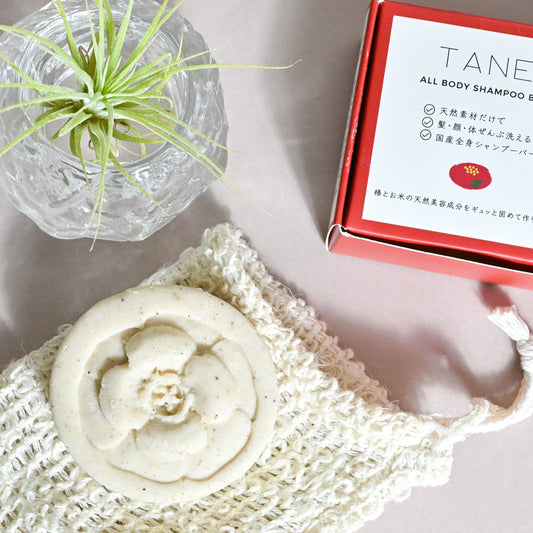
Whole-body shampoo bar "TANE" made from camellia seeds from Toshima without waste ▼▼▼


Small Choices Create a Big Future
Using upcycled ingredients is not just about being eco-friendly.
It is an action that supports the "three pillars" for revitalizing communities, protecting the planet, and preserving resources for the future.
・Regional Revitalization: Utilizing local resources to keep jobs and people in the community.
・Waste Utilization: Giving new life to usable items instead of discarding them.
・Circular Economy: Reusing resources repeatedly to eliminate waste.
These three are not separate, but interconnected.
Utilizing waste creates a circular flow, and that circularity creates new industries and employment in the region.
And the vitality of that region further strengthens efforts to protect the environment.
What You Can Do
The first step in upcycling that even elementary school students can take is to "use things carefully."
Use notebooks until the very last page,
Pass clothes down to someone else,
Turn empty bottles into vases…
These are all excellent forms of upcycling.
And when you're choosing products in a store,
try to think, "What materials is this made from?"
If it's made using local resources or waste,
choosing that product becomes a way to support the future.
Upcycling is the magic that turns "discarding" into "utilizing."
By spreading this magic, we can protect our communities, our planet, and our future.
That small choice in your hands can change the world 100 years from now.
🧭 Also, check out these articles:
→ 【Ethical living feels good, doesn't it? The power of choices that change your daily life little by little】
→ CHANT's thoughts on the global environment: To care for the Earth is to care for people